C27 Class
Industrial Wi-Fi 7 + Bluetooth 6.0 — engineered for Physical AI
Long-range Bluetooth ranging, Wi-Fi sensing and location, and a dedicated Wi-Fi Aux Radio — converged in a single industrial-grade module on the Qualcomm FastConnect C7700.
Discover More Technical & Downloads
Tri-band 2×2 MIMO with always-on Wi-Fi Aux Radio for ultra-low standby, MLO, 320 MHz, 4K QAM

Proximity & ranging — Wi-Fi Location (802.11az) + Bluetooth Channel Sounding (cm-class)

RF to periphery pads — your antenna, your system, your design antenna freedom

Bluetooth 6.0 2×2 — Tx Beamforming + MRC, BLE Long Range, LE Audio
Build with QUALCOMM®
The C27 deploys the Qualcomm® FastConnect™ C7700 connectivity platform — Wi-Fi 7 + Bluetooth 6.0, tri-band 2×2, with advanced proximity capability, an always-on Wi-Fi Aux Radio, and flexible host integration over PCIe, USB, or SDIO.

One industrial Wi-Fi 7 module. Three converged radio domains.
Long-range Bluetooth ranging · Wi-Fi sensing and location · Wi-Fi Aux Radio.
The AIRETOS C27 brings together three previously-separate radio domains in one industrial Wi-Fi 7 + Bluetooth 6.0 module. For industrial OEMs designing the next generation of physical-AI systems, the redesign target shifts from 'add another radio' to 'do more with one industrial-grade module.' In several deployment classes the C27 competes for the same bill-of-materials budget that previously went to a Wi-Fi module plus a separate sub-GHz long-range or low-power wide-area client radio.
The AIRETOS C27 Class opens a new generation of industrial wireless integration: a complete platform built on the Qualcomm FastConnect C7700, designed for compute, edge AI, robotics, and immersive applications. The C27 delivers tri-band 2×2 MIMO with PHY peaks of 5.76 Gbps (802.11be, two streams, 320 MHz, MCS13), and Multi-Link Operation (eMLSR) across the 2.4, 5 and 6 GHz bands. It pairs that throughput with an always-on Wi-Fi Aux Radio for ultra-low standby scan and RSSI monitoring — and with Wi-Fi Location (802.11az) plus Bluetooth Channel Sounding for centimeter-class proximity and ranging. Wi-Fi Sensing via native Channel State Information (CSI) capture extends the module beyond connectivity into presence and motion awareness.
The C27 also routes RF signals out to the LGA periphery, leaving antenna topology — chip, PCB-trace, or external — to the system designer who knows the final enclosure best.
The C27 Class reflects VOXMICRO's continuing commitment to leading wireless connectivity technologies.

Qualcomm ASIC

Powerful Performance

Latest Wireless Standards
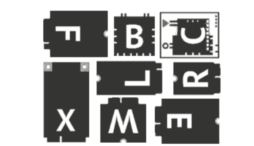
Carrier choice


802.11be Wireless (Wi-Fi 7)

Multi-Link Operation, tri-band

Target Wake Time + Wi-Fi Aux Radio

4K QAM density

Multi-User MIMO

World pre-certified

Long-Range BT Ranging
Built on the Qualcomm FastConnect C7700 silicon foundation that supports Bluetooth 6.0 with Bluetooth Channel Sounding and BLE Long Range (Coded PHY). Channel Sounding enables sub-meter ranging between Bluetooth-enabled devices; BLE Long Range extends connectivity across distances that previously required a dedicated long-range radio. For asset tracking, factory-floor coordination, and equipment localization — one combo module replaces what was a Wi-Fi module plus a dedicated long-range radio.

Sensing and Location
Supports Wi-Fi Location (IEEE 802.11az) and Channel State Information Capture. The same Wi-Fi 7 radio that moves the data senses the space, locates devices within it, and exposes channel-state information to higher-layer applications — motion detection, presence sensing, gesture recognition, and centimetric ranging when paired with capable infrastructure. The radio that carries the network also becomes a perception layer for the system on top of it.

Dedicated Wi-Fi Aux Radio
Includes a separate Wi-Fi Aux Radio that performs background scanning concurrent with the primary Wi-Fi 7 radios, and listens for inbound traffic while the primary radios are in standby. Improved spectrum awareness and wake-from-sleep responsiveness without compromising the data plane — relevant for battery-driven and duty-cycled industrial endpoints.

Flexible Form Factor
Other than for direct SMT, the C27B Series is available on carriers with edge connectors for standard slot-in form factors: M.2 E-Key (2230), M.2 B+M-Key (2242), and miniPCIe (Half-Mini).

Industrial temperatures
Designed for operation in Industrial environments spanning −40 °C to +85 °C.

World Certifications
The C27 is being prepared for approvals across the major domains of the USA, Canada, EU, Japan, South Korea, China and more countries.

Designed for Robotics, AGVs & Autonomous Mobile Robots
For mobile platforms that need to roam between access points while running real-time control loops in vibration- and shock-prone environments.
- Multi-Link Operation architecturally enables lower-disruption roaming by pre-establishing on a secondary link before transitioning the primary
- Wi-Fi Aux Radio continuously scans for candidate APs without dropping the primary connection — the foundation for fast handover in mobile deployments
- Pad-out RF eliminates on-module coax mating points — a known fatigue path under continuous vibration
- Compact 12 × 16 mm LGA frees enclosure volume for sensors, batteries, and compute payloads

Designed for Drones, UAVs & Aerial Platforms
For airborne platforms where every gram matters, antennas are integrated into the airframe, and link continuity over distance is mission-critical.
- Pad-out RF + integrated antennas removes coax connectors and cables — gram-level weight savings that compound across the airframe
- MLO across 2.4 / 5 / 6 GHz lets the link adapt to interference and range conditions in flight
- BLE Long Range (Coded PHY) extends control / telemetry links beyond standard BLE range
- Industrial −40 °C to +85 °C for high-altitude and exposed-environment operation

Designed for Edge AI Gateways & Inference Appliances
For compact, distributed compute nodes where antenna geometry, host throughput, and presence awareness all matter.
- Wi-Fi Sensing (CSI capture) turns the wireless link into a presence and motion sensor — no additional hardware
- Wi-Fi Location (802.11az) + BT Channel Sounding add centimeter-class proximity and ranging for spatial intelligence
- PCIe Gen 3 host interface for low-latency data return to the inference engine; USB 3 and SDIO 3.0 on roadmap for non-PCIe hosts
- Pad-out RF supports distributed antenna placement across non-trivial enclosure geometries
All the Wi-Fi 7 advanced features and tools: empower system design with the latest in Wi-Fi 7 power management, Target Wake Time, an always-on Wi-Fi Aux Radio for ultra-low-power scan and RSSI monitoring, Multi-Link Operation across 2.4 / 5 / 6 GHz, support for 320 MHz channel bandwidth on 6 GHz at 11be speeds, low-power PCIe Gen 3 (with L1 sub-state) interface, Wi-Fi Location (802.11az) precision ranging, Wi-Fi Sensing via Channel State Information (CSI) capture, Dynamic Frequency Selection (DFS, radar detection), and more.
- Complemented by a complete HDK including an Evaluation Board and an LGA CoB socket tool, for access to all PCIe, USB, UART, I²S/SoundWire, I²C, and debug interfaces.
- Systematically supported with open-source drivers for Linux (mainline kernel and ath driver lineage) and Android, as well as Closed Source Drivers (CLD) for advanced features.
- Combo Bluetooth 6.0 2×2 on-board: dual-radio architecture with Tx Beamforming + MRC; Bluetooth Channel Sounding for centimeter-class distance measurement; BLE Long Range (Coded PHY); LE Audio (LC3); Isochronous Channels (CIS/BIS) for broadcast and unicast audio; Decision-Based Advertising Filtering.
- Flexible configuration: chipset variant, CoB + carrier, choice of BT interface bus (USB or UART), antenna and grade.
- Roadmap: USB 3.0 and SDIO 3.0 host-interface variants in development for designs without PCIe.
-
RF routed to LGA periphery pads
"
"Industrial OEMs designing for physical AI no longer need a Wi-Fi module plus a long-range radio plus a sensing radio plus a ranging tag."

Module-down convenience. Chip-down RF flexibility.
Going chip-down with a Wi-Fi 7 + BT 6.0 SoC means owning the RF front-end design, the regulatory certification, the manufacturing qualification, and the firmware bring-up. It buys maximum antenna flexibility — at the cost of six to twelve months and a dedicated RF lab.
Going module-down with most pre-certified modules means buying back that time and that overhead — but accepting whatever antenna topology the module vendor chose to bake into the part.

Pick one — get both:
- Module-down convenience — pre-tested RF, pre-certified for FCC / IC / CE / RoHS, drop-in for production with no in-house RF design
- Chip-down antenna freedom — RF routed to LGA pads, antenna decision belongs to you (chip, PCB-trace, external dipole, distributed array)
- Pre-certified antenna paths — selected chip antennas and OXFORDTEC dipoles already covered under the modular approval
- Custom antenna support — bring your own; we'll work with you to extend the modular approval
The result: the C27 fits the integrator who wants to ship in six months instead of eighteen and needs the antenna topology their enclosure actually demands.
Choose your form factor
One 12 × 16 mm LGA core, three carriers from a single design.
LGA Chip-on-Board
MSRP from $ 39.95

C27 Series B · 12 × 16 mm
- Soldered, compact 12 × 16 mm, 108 pads
- RF on two 50 Ω pads — your antenna
- PCIe Gen 3 + BT UART or USB
- SDIO 3.0 / USB 3.0 variants on roadmap
- −40 °C to +85 °C
M.2 E-Key
MSRP from $ 44.95
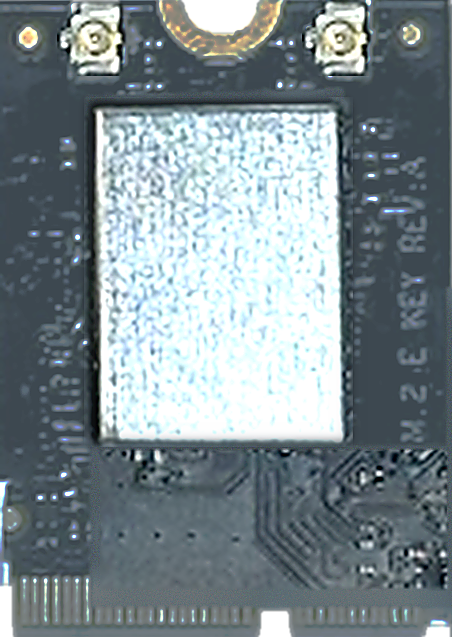
C27 Series R · M.2 2230
- Standard M.2 E-Key slot
- 2× MHF1 antenna connectors
- PCIe + BT UART or USB
- −40 °C to +85 °C
M.2 B+M-Key
MSRP from $ 44.95
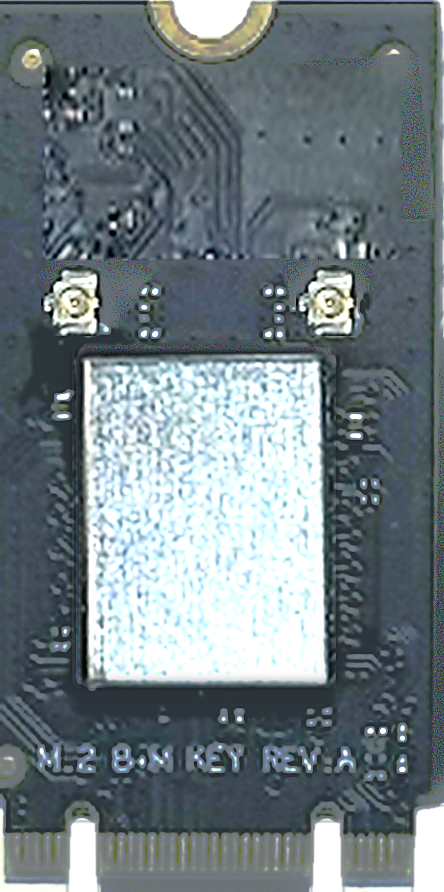
C27 Series M · M.2 2242
- Standard M.2 B+M-Key slot
- 2× MHF1 antenna connectors
- PCIe + BT USB
- −40 °C to +85 °C
mPCIe Half-Mini
MSRP from $ 44.95
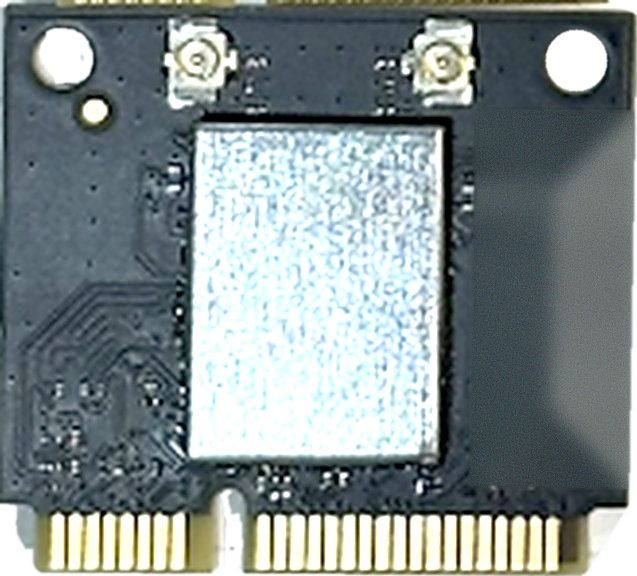
C27 Series H · 30 × 26.8 mm
- Standard Mini PCIe slot, half size
- 2× MHF1 antenna connectors
- PCIe + BT UART or USB
- −40 °C to +85 °C
Engineering samples shown; production units carry final marking. MSRP = list price in USD; project pricing on request.
Technical & Downloads
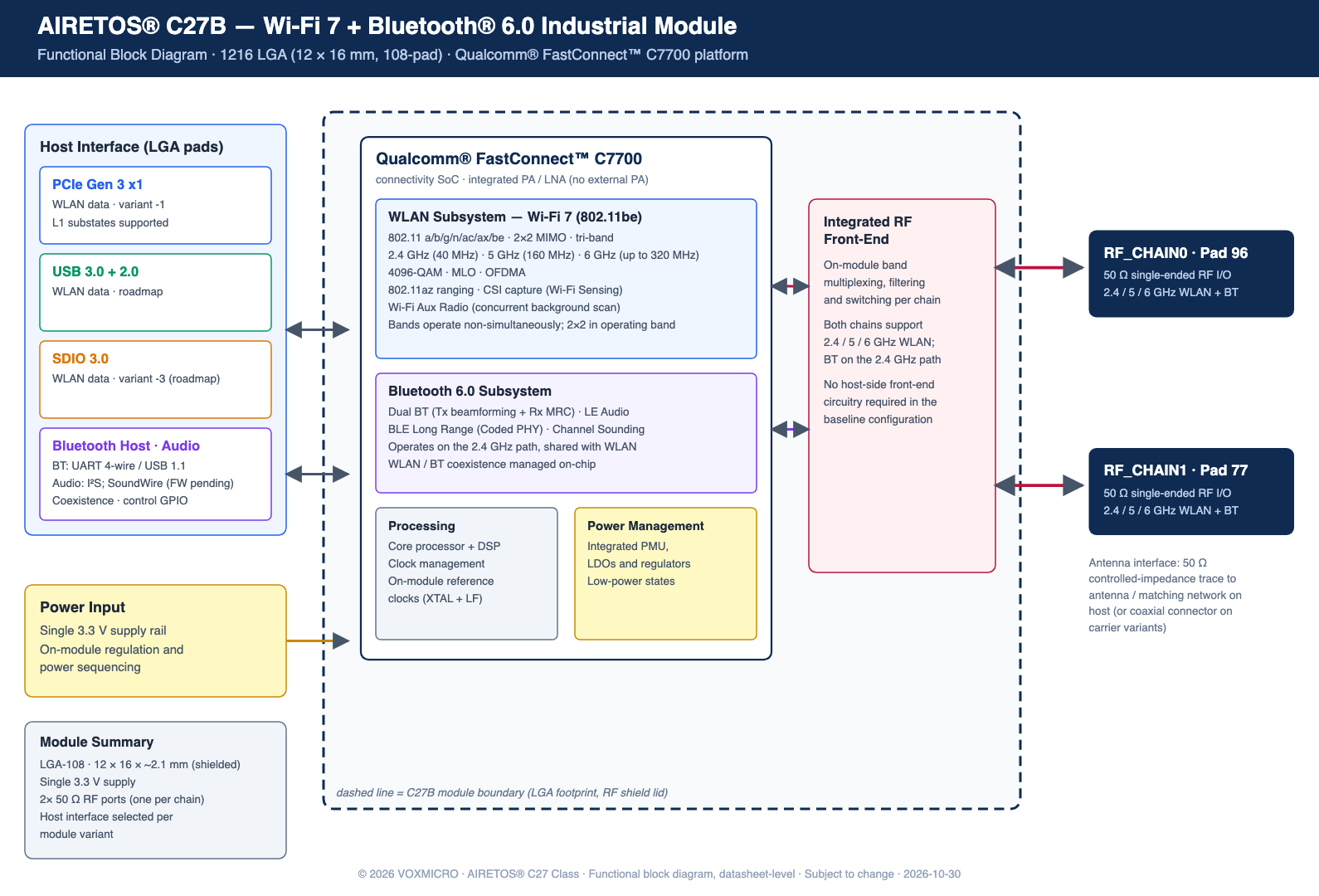
Functional block diagram of the C27B LGA core on the Qualcomm® FastConnect™ C7700. SDIO 3.0 and USB 3.0 host-interface variants are on the roadmap.
Request engineering samples
Engineering samples of the AIRETOS C27 Class are available now to qualified industrial OEMs. Tell us about your design; we reply by e-mail. The same form requests documents and evaluation hardware.